
A mid-market company with 200 employees running a typical modern data stack is spending somewhere between $100,000 and $150,000 a year on analytics tooling before a single dashboard ships. The math is unkind once you do it. Five Tableau Creator licenses at $900 each, fifteen Tableau Explorer licenses at $504 each, thirty Tableau Viewer licenses at $180 each — that line alone runs about $17,500 a year. Add the Snowflake compute baseline, the Fivetran connectors, dbt Cloud for transformations, and a ChatGPT Team subscription for the analytics group, and the soft number lands closer to $130,000.
That is the bill before headcount. Three senior data analysts at a loaded cost of $150,000 each adds another $450,000. The analytics function consumes roughly $580,000 annually to produce work that, in most organizations, business partners stop trusting within two quarters of any meaningful schema change. The dashboards drift, the queries get rewritten by different hands, and the trust deficit re-opens the ticket queue that the dashboards were supposed to close.
Most conversations about AI cost savings in analytics focus on the tooling line. The interesting cost actually lives somewhere else.

Where analytics costs really live
The line-item cost of BI tooling is the part that shows up in procurement. It is not the part that scales nonlinearly with company size. The four cost categories that actually drive the analytics budget over time are:
-
Per-seat licenses on the consumption tier. Tableau and Power BI price viewing capability per user, which means the cost grows linearly with headcount whether or not those users open the dashboard. BI tool usage typically runs around 25% of provisioned seats across enterprise deployments, meaning organizations routinely pay $180 a year for Viewer licenses that go untouched.
-
Analyst time spent on repetitive ad-hoc queries. This is the largest cost in most analytics functions and the hardest to see. A senior analyst earning $150,000 loaded who spends 60% of the week fielding "can you pull this number" requests is producing roughly $90,000 a year of work that any reasonable AI layer could handle deterministically.
-
Schema-drift rework. Every time the underlying data model changes — a column renames, a new join condition, a deprecated metric — every downstream dashboard, every notebook, every Slack-pinned query becomes a candidate for breakage. The cost is not the fix. It is the trust loss that triggers months of validation work after a business partner reports a number that doesn't match the source of truth.
-
LLM token spend with no governance. The newest line item, and the one that grows fastest. Teams that bolt ChatGPT or Claude onto their data warehouse without a verification layer end up paying for token throughput on queries that get regenerated from scratch every time the same question is asked. The same monthly cohort report runs 40 times because no one bothered to cache the verified SQL.
These four costs compound. None of them is reduced by adding another AI tool to the stack. Most are made worse.
Why bolting AI onto BI doesn't reduce cost
The default reaction to rising analytics costs is to add an AI layer on top of the existing BI stack — Tableau Pulse, Power BI Copilot, or Looker with Gemini. The bet is that natural language access reduces the analyst dependency, which reduces the queue, which reduces the bill.
The bet is plausible. The execution rarely delivers because the AI layer is priced as another per-seat product. Tableau Pulse, Power BI Copilot, and Looker's Gemini integration all add cost on top of the underlying BI license, not in place of it. A mid-market company that was spending $17,500 a year on Tableau is now spending $22,000 to $30,000 once the AI tier comes online. And the AI layer regenerates SQL on every turn, which means the hallucination risk that the FP&A team was trying to avoid is now part of every business partner's workflow rather than contained to the analyst's desk.
The cost reduction the AI bolt-on promises is real but small — maybe 10-15% of analyst queue time, offset by the new license fee and a new rework category. The structural economics do not change.
What changes when the verification lives in the data layer
The cost structure shifts when the verification moves from the analyst's head into a queryable, reusable artifact. A verified SQL query that lives in the warehouse — peer-reviewed, period-aware, RLS-honoring — has different economics than one that sits in a notebook and gets rewritten each time someone asks.
Specifically, a verified query has three properties that change the analytics budget. It is reusable across surfaces, because the same SQL can power a dashboard, answer a natural-language question in chat, generate variance commentary, and feed an agent file dropped into Claude Code or Cursor. The marginal cost of the next answer is the compute, not the analyst's time. It is portable across LLMs, because when the verification lives in a Markdown skill file rather than inside a vendor's proprietary semantic layer, the team can switch between Anthropic Claude, OpenAI, Google Gemini, or Mistral without rebuilding the analytical logic. And it is deterministic at execution, because no LLM is rewriting the SQL on each turn — the model routes a business question to a verified skill, the skill runs, and the same answer comes back every time.
This is where AI-native analytics platforms that compile verified queries into a portable skills library produce a fundamentally different cost curve than per-seat BI plus an AI bolt-on. The compile-once model means the analytics function pays for verification once and amortizes it across every business partner, every surface, and every LLM runtime the team uses. Per-seat economics give way to per-team economics. The line item that grew linearly with headcount stops growing.
What the new cost model looks like in practice
A team that migrates a typical 200-person company's analytics function from a per-seat BI plus AI bolt-on architecture to a verified-skill architecture typically sees three line items move.
Tooling spend on per-seat consumption drops because the platform is priced flat per team rather than per viewer. A Pro tier at $99 a month replaces $17,500 of Tableau licenses for organizations where viewing is the primary use case. The Creator tier still exists for analyst authoring, but the long tail of Viewer licenses — the 60-70% that go unused at typical adoption rates — goes away.
Analyst hours redirect from ad-hoc queries to query authorship. A senior analyst whose week was 60% reactive becomes a senior analyst whose week is 60% productive, authoring the verified skills that the rest of the organization queries. The team's effective output rises without adding headcount.
Token spend stays predictable because the LLM is routing to a verified skill rather than regenerating SQL on every turn. A team that was burning $3,000 to $5,000 a month on ungoverned ChatGPT queries against the warehouse typically lands in the $300 to $800 range once routing replaces generation.
The total reduction in analytics-function spend, for a typical 200-person company, sits in the 25-40% range — not because the work disappears, but because the same work amortizes across surfaces it never used to reach.
The forward question
The economic case for moving analytics to a verified-skill architecture is real but it is not the only case. The harder question is what the function looks like in 36 months if the verification stays in analysts' heads.
The answer most data leaders arrive at, eventually, is that the function gets cheaper but less useful. Per-seat BI licenses keep growing with headcount. Analyst hiring stays flat under budget pressure. The queue deepens. Business partners stop asking and start guessing. The analytics function becomes the part of the organization everyone routes around to make decisions faster.
The teams that move to verified-skill architectures early do not necessarily spend less in year one. They spend the same and produce three to five times the analytical surface area. That is the real cost story — not what gets cut, but what becomes possible at the same line item.
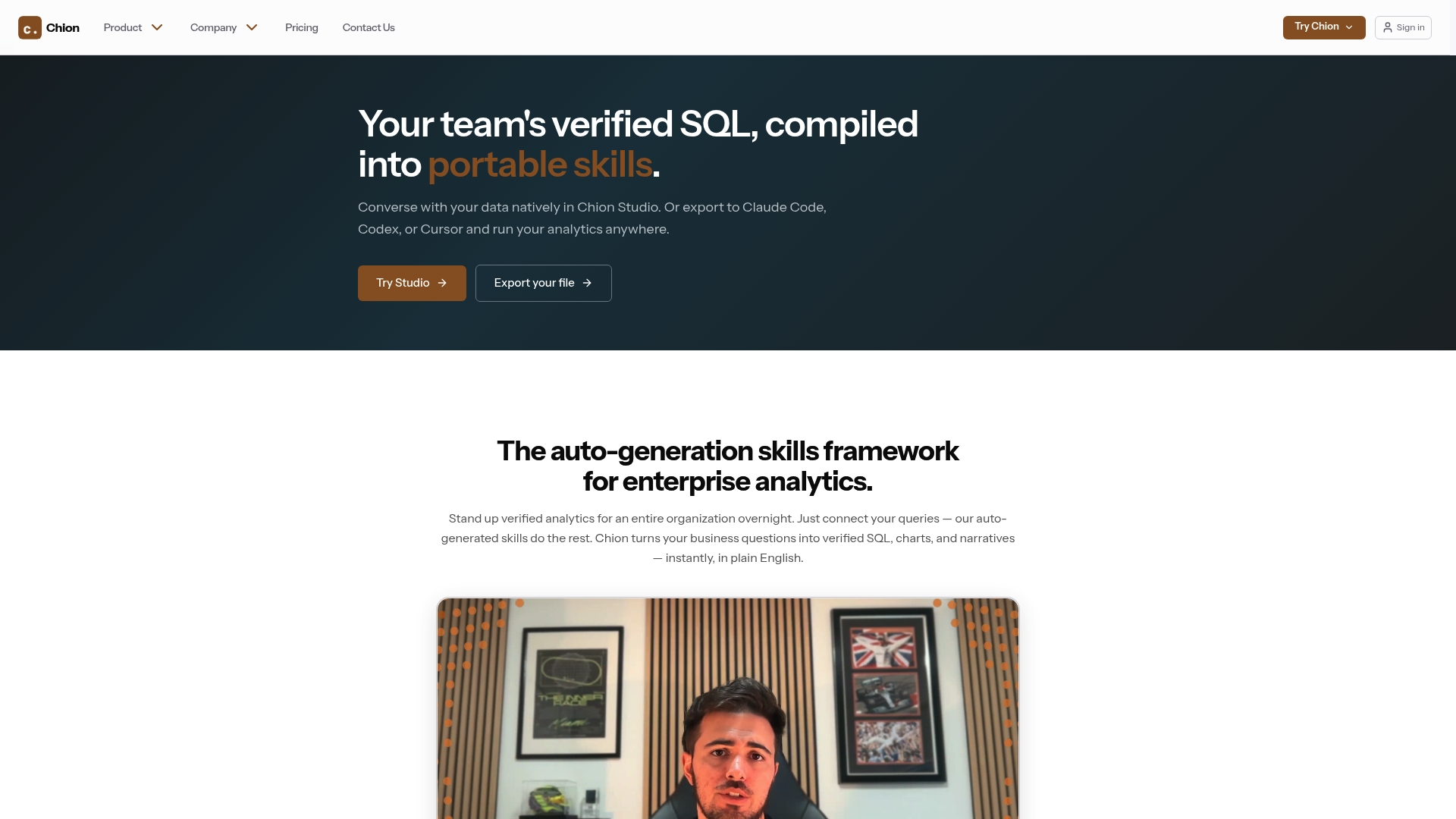
With Chion, you connect your database, upload queries and artifacts for context, and ask questions in natural language. The platform returns analytical responses, query discovery, and verified SQL query generation for analysts with full traceability. For budget forecasting workflows, this means faster variance analysis, governed query generation, and conversational analytics for finance teams that need to interrogate actuals without waiting on a data engineering queue. Visit the Chion analytics platform to see how it fits your forecasting architecture.